02 Annual highlights

In FY23
across the organisation
the Future Fund
Portfolio activity in 2022–23
Our 2021 position paper, A New Investment Order, referred to a range of paradigm shifts that are impacting global financial markets and investment portfolios.
These shifts include inflation regimes, deglobalisation, populism, climate and decarbonisation, and changing correlations, meaning the longer-term investment environment – the new investment order – is expected to be more complex, more volatile, and ultimately more challenging for investors.
We believe that forward-looking returns will be more difficult to earn, and we need to refresh how we invest to continue to achieve our investment purpose.
We followed up this first paper with a second in late 2022 titled The Death of Traditional Portfolio Construction? setting out how we are responding to this investment challenge.
Consistent with these two papers, we have evolved our portfolio to make it more resilient to multiple possible scenarios. This has involved making over $60 billion of changes across the portfolio over the last year, with repositioning occurring across all asset classes.
The following diagram outlines our investment process and portfolio evolution since 2020.
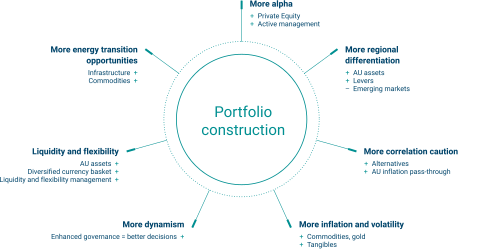
Over the 2022–23 financial year the bulk of portfolio activity centred on continuing to build resilience to the risks and the range of possible scenarios presented by the new investment order, including sticky inflation leading to prolonged higher rates, higher geopolitical risks, and the risk of a global recession. However, we also pursued and executed on investment opportunities to generate long-term returns.
Focusing on some of the highlighted ‘zones’ in Diagram 1:
- We continued to position the portfolio at around the middle of the range and made changes towards investments that rely on investor skill rather than market risk – more alpha – reflecting our belief that this approach will be better rewarded in an environment where higher inflation and interest rates make market/beta returns less certain. An example of this change was a shift back to active management in listed equities, with a focus in FY23 on Australian small cap equities.
We also continued our investment in early-stage venture opportunities through our high-quality private equity managers, noting that private equity activity slowed across the year. A re-rating of property valuations also occurred throughout FY23, although we did add some new property managers across the year to position us for interesting opportunities ahead.
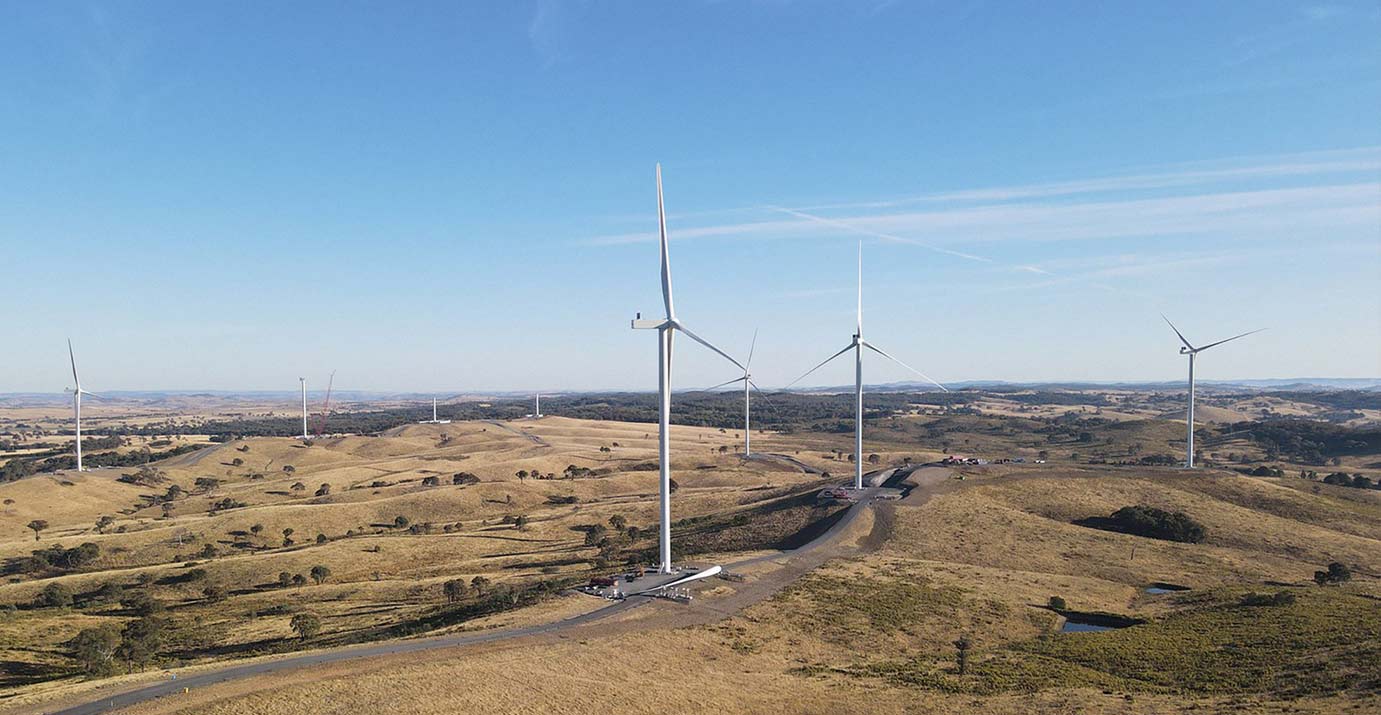
Finally, we continued to combine our rich portfolio data sets with new technology-based tools to enhance our understanding of the drivers of returns delivered by investment managers, to better identify skill. - We maintained our preference for domestic assets – more regional differentiation – with their ability to hold value in a higher-inflation environment and those that are well positioned to assist in the energy transition thematic – more energy transition opportunities. Examples of portfolio activity here include the Future Fund’s investment in Sydney Airport and an additional investment in Tilt Renewables which went to funding the construction of the Rye Park Wind Farm in NSW.
Under regional differentiation we also reduced our exposure to China, reflecting increased intervention in market sectors and the accumulation of challenges to their existing economic growth model. Finally, under regional differentiation we continued to grow our exposure to private lending opportunities in Australia, participating in the growth of non-bank lending in this market. - We have had significant focus on creating liquidity and flexibility across the portfolio to ensure we are able to direct capital to opportunities that appear likely to develop in the context of a quickly changing macro environment. This has included increasing the amount of developed market currency we hold, reducing our foreign exchange hedging requirement that can be a drain on our liquidity, as well as increasing the amount of domestic assets in the portfolio.
We have also expanded the remit of our new treasury management function beyond liquidity provision to include flexibility management to allow us to harvest more investment opportunities when they arise. - Under more dynamism, we have refined our investment delegations and governance arrangements to ensure our investment decision-making is fit-for-purpose in a more volatile investment environment. We have also further uplifted and refined our dynamic asset allocation process and governance across the year to better utilise flexibility and capture mispricing opportunities across liquid markets.
- Consistent with the structurally higher and more volatile inflationary scenario – more inflation – we made a number of changes to our investment portfolio in rates and currency markets and built a meaningful exposure to commodities. These changes totalled more than A$40 billion across the year.
- Finally, our investment activity in the alternatives portfolio focused on reducing hedge fund exposures that were challenged by the new investment order and replacing them with new ones that are truly diversifying in this longer-term investment environment – more correlation caution – and generating liquidity for the total portfolio.
Similar portfolio activity occurred for the Medical Research Future Fund, the ATSILS Fund, the Future Drought Fund and the Disaster Ready Fund. We continue to diversify those four funds and build exposures to high-conviction and capacity-constrained managers.
Tilt Renewables signs major energy deal

The Future Fund is one of the largest investors in renewable energy in Australia.
In June 2023 AGL Energy signed a 15-year power purchase agreement (PPA) to take 45% of the output produced by the Rye Park Wind Farm in regional New South Wales, owned and operated by Tilt Renewables.
Jointly owned by the Future Fund, Queensland Investment Corporation and AGL Energy, Tilt Renewables is the largest operator and developer of utility-scale wind and solar projects in Australia.
The agreement is the first PPA to be signed since the three organisations acquired Tilt Renewables’ Australian operations in 2021.
The new agreement will provide AGL Energy with 513 GWh of renewable energy. This is electricity that could otherwise be sourced from the grid at a higher emissions intensity – 513 GWh of energy per year corresponds to approximately 400,000 tonnes of greenhouse gas emissions annually – the equivalent of removing approximately 110,000 average Australian internal combustion engine cars each year.
Investing insights
Our joined-up approach to investing
The Future Fund has always had a joined-up, total portfolio approach to investing.
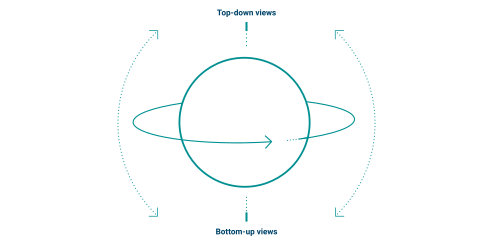
When constructing the portfolio, we bring together top-down and bottom-up views. Our top-down experts look at the global economy, financial markets and geopolitical developments, and think about how these will impact the total portfolio. Their thinking is also influenced by the level and nature of the insights coming from our bottom-up specialists, who look across the world for the best assets and investment opportunities, thinking about whether these opportunities offer sufficient reward for the risk involved and having regard to the big-picture context evaluated by our top-down experts.
This joined-up, integrated approach means we don’t set a fixed strategic asset allocation from the top and then require those allocations to be filled across each of the investment sectors. Instead, our investment professionals share insights and perspectives and take a whole-of-portfolio approach to making investment decisions.
This is the cornerstone of our investment philosophy, and we consider it a key comparative advantage that significantly improves the prospect of meeting our long-term investment objectives. It challenges our people to think broadly, test and question their views and the thoughts of our external partners, and compare the merits of any one investment opportunity over another.
Building the ‘best portfolio’
Working together to harness curiosity, diversity of perspective and innovation, we aim to build our ‘best portfolio’ for each mandate, at each point in time.
Three broad activities underpin this best portfolio: (i) setting broad market (or ‘beta’) exposures, (ii) identifying our best specific manager or asset exposure ideas across all sectors, and (iii) integrating and sizing our highest-to lowest-conviction ideas for the total portfolio. All this activity is inherently dynamic because the outlook, pricing and opportunities are always changing – and this necessarily involves the whole Investment Team.
We believe a truly joined-up Investment Team is critical to building our best portfolio.
DAA the Future Fund way
Our dedicated Dynamic Asset Allocation (DAA) Team, which was established in mid-2021, leads our beta exposure and our Strategic Opportunities and Integration Team leads integration.
The DAA Team collaborates across the whole Investment Team to review strategy and provide top-down perspectives, as well as source bottom-up ideas and insights. The internal Economics and Capital Markets Team and key external partners provide a diversity of macroeconomic views and market insights.
The DAA Team blends these inputs into frameworks and provides the Investment Committee and Board with recommendations across three horizons:
- Structural risk appetite (10+ years): the average risk level the Board has decided our portfolios should take to meet their mandates, measured in EEE terms.
- Long-term strategy (3–10 years): our best long-term strategy for our mandates, integrating broad market exposures and sector opportunities.
- Medium-term strategy (less than 3 years): our best current positioning around our long-term strategy given (i) market prices compared to long-term fundamental value, and (ii) the cyclical outlook compared to what is priced.
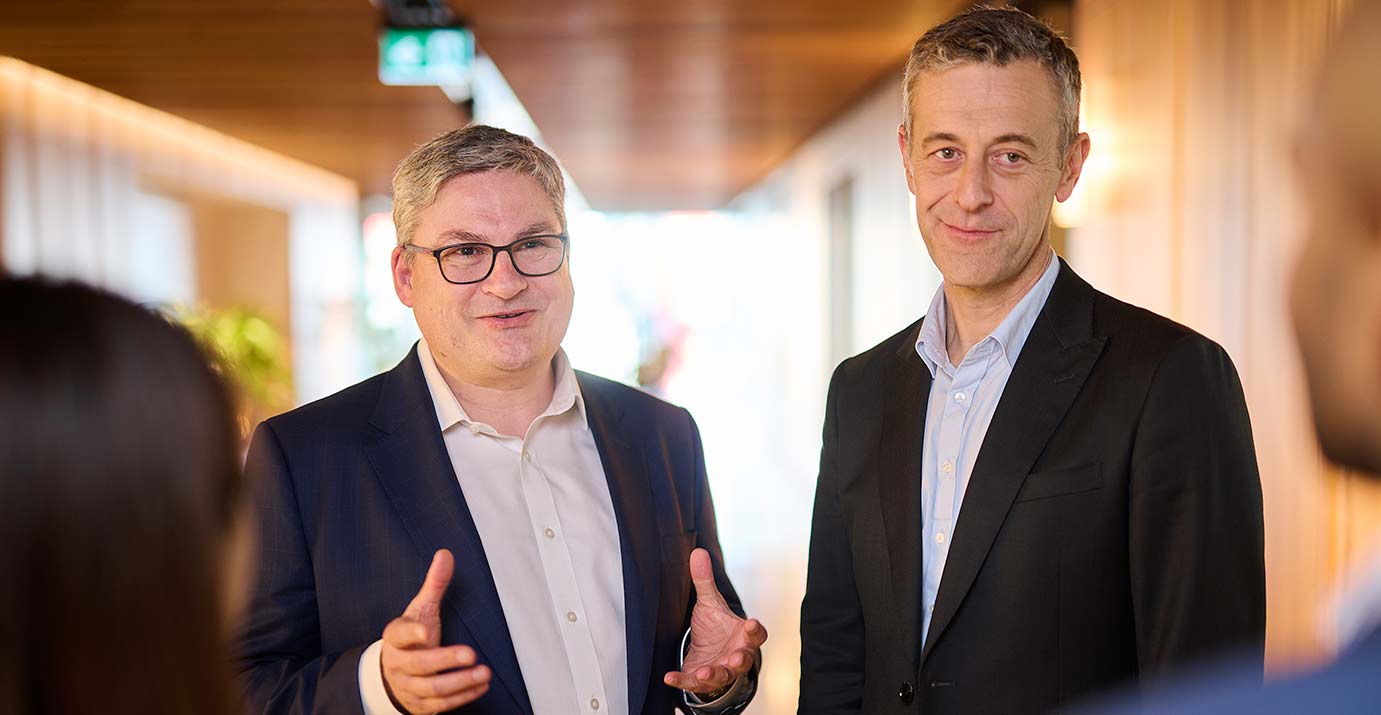
“We are different from a traditional asset allocation team in that we take an inherently dynamic and integrated approach,” said Sam Killmier, Head of DAA. “If our view on the secular outlook changes due to a major development, we can change our long-term strategy, rather than being tethered to a long-term SAA or reference portfolio.
“We integrate the beta ideas with the bottom-up opportunity sets, which means our team works directly with our talented sector teams to find the best opportunities for the total portfolio at any point in time. It initially takes more effort to be joined-up, but the benefits far outweigh this over time.”
DAA-driven decisions numbered more than 30 in FY23, representing more than $60 billion in exposure. This reflects continuous and concerted effort across the organisation to help improve our chances of achieving our long-term mandates.
The Future Fund Academy goes live

The Future Fund Academy was established in FY23 to preserve and grow our culture and develop our people. The Academy centralises the Future Fund’s learning and development activities.
The Academy has three main objectives:
- To codify and teach the Future Fund culture
- To be the custodian of our evolving culture toolkit
- To teach personal, leadership and technical skills.
The culture that was established at the inception of the Future Fund encouraged behaviours and mindsets that have allowed it to succeed over the past 17 years. Codifying this unique and purposeful culture and ensuring it is understood and embedded with every new Future Fund employee is vital to the organisation’s ongoing success.
The Academy is also a focal point for leadership and technical skills training and ensuring a deliberate approach to and focus on our people’s development journeys – personal and professional – throughout their Future Fund careers.
These programs include courses on our unique joined-up investment framework, how we select our investment partners, emerging leader content and supporting our leaders as they continue to grow and advance.
Throughout FY23, the Academy focused on defining its bespoke infrastructure and governance framework and designing and delivering the first components of its base program.
The Academy rolled out 63 programs including 23 new starter orientation days as well as skills training focused on negotiation, verbal skills and presentation skills. The Academy Team also transitioned some technical learning courses from outsourced offerings to in-house while maturing the facilities, technology, training staff and culture toolkit.
“This year was, in many ways, the ‘setting-up’ year for the Academy,” said Niels Maartens, Head of the Future Fund Academy. “We focused on getting the infrastructure and plans in place to deliver ongoing content for the years ahead, while delivering on the established leadership programs, skills courses and orientation for new starters.
“I’m proud of how we have worked together with so many people at the Agency and am beyond excited to show our people all the new content launching over the coming months.”
One highlight this year was the organisation’s inaugural investment competition, run under the auspices of the Academy. This six-week program saw seven diverse teams with a total of 36 participants from across the organisation develop and present pitches for an investment opportunity looking ahead to 2050.
Cross-functional teams from different levels and roles learned how to develop an investment idea in line with the Future Fund framework and process. They were also taught how to present to and engage an audience in a pitch scenario and then given the opportunity to pitch their concept live to a panel of judges in front of the entire organisation.
Members of the Investment Team offered mentoring and coaching throughout the program. Teams were assessed on innovation, potential returns, team diversity and presentation skills.
The winning team was awarded the inaugural Paul Costello Cup for Best New Investment Idea. The Cup was named after the Agency’s founding leader, Paul Costello, whose legacy of creating our unique way of investing – working as one team across one portfolio – remains a key foundation of our culture today.
Looking ahead to FY24, the Academy will scale up to full operations. This includes running dedicated leadership courses for all levels and technical investment training courses that teach our unique way of investing. Around-the-clock online courses will also be available to develop skills for future success so that staff can engage with learning to suit their needs.
Over time, the vision for the Future Fund Academy is to be the heart of learning and development across the organisation.
Building knowledge and sharing insights
At the Future Fund we are fortunate to have access to a high-calibre global network of external investment managers, industry experts, think tanks and thought leaders who provide our people with information, perspectives and insights into the world around us.
To make the most of this network and provide our people with exposure to these world-leading perspectives, we run a comprehensive internal events program in which guest speakers present a wide range of topics to our people.
During FY23 we had the opportunity to hear from the CEOs of the Milken Institute, Tilt Renewables, Wellington Management and Melbourne Airport, as well as a number of strategists, demographers, economists and technology experts.
Topics this year spanned geopolitics, macroeconomics, multiculturalism in the workplace, cloud computing, infrastructure investing, renewable energy, asset management industry dynamics and the aviation sector.
As part of this program, some of our internal leaders also regularly present live to our people on a range of topics, including a ‘Quarterly State of the Market’ series delivered by senior members of our Investment Team in a panel session format.
We use the vast depth of knowledge and insights we glean through this program to develop our own perspectives, views and concepts that enable more informed investment decision-making and help underpin parts of our thought leadership program, including position papers and public speeches.
Senior members of the Future Fund also regularly attend and speak at various conferences and events around the world. In FY23 we spoke at over 65 conferences and events around Australia, as well as in Tokyo, California, Singapore, Toronto, London and beyond. This is an important component of our thought leadership program, providing the opportunity for our leaders to contribute to and learn from important conversations on relevant investment industry issues.
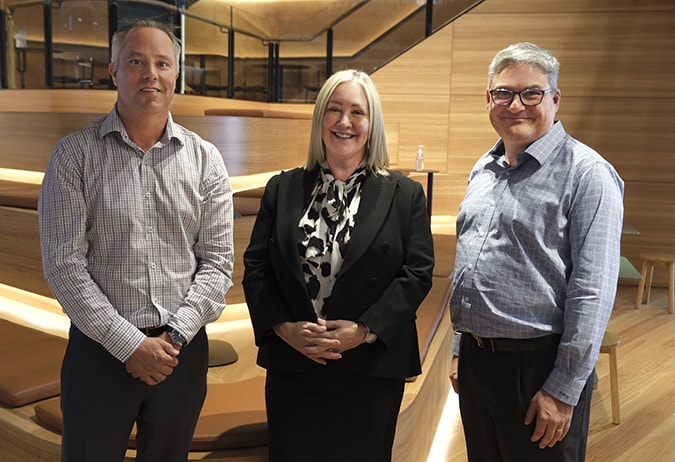
Image: CEO of Australia Pacific Airports Corporation (APAC) Lorie Argus with APAC Board Members, Future Fund Director of Unlisted Infrastructure and Timberland, James Fraser-Smith (L) and Future Fund CEO, Raphael Arndt (R).
The search for alpha

Alpha and skill-based strategies have always been integral to the Future Fund’s approach. With the reversal of several factors that have fuelled strong economic performance for decades, the role of beta is increasingly challenged and the role of alpha is more important than ever.
The divergence of economies means companies can better distinguish themselves in a more difficult environment. As a result, active alpha-seeking strategies in our $65 billion listed equities program are increasingly attractive, provided we can be confident that excess returns will be sustained.
Throughout the year our research and analysis have concluded that a persistent alpha opportunity exists in the Australian small cap space, underpinned by a significant information inefficiency. Relative to other segments of the domestic equity market, Australian small company stocks have a lower level of analyst coverage, higher dispersion in analyst forecasts and greater forecasting error.
In addition, the broad, diversified nature of the small company benchmark permits active managers to capitalise on proprietary insights by taking meaningful positions relative to the index and generate stock-specific alpha.
In FY23 the Future Fund began a new partnership with Maple-Brown Abbott, a domestic, privately owned boutique fund manager.
By adopting an active strategy in Australian small companies, we are backing the investment management industry in Australia and enhancing our support for the country’s emerging corporate leaders through considered capital allocation and constructive engagement.
Investing in our people

As the Future Fund continues to grow and evolve, identifying and developing our internal talent pipeline and building bench strength have continued to be key focuses.
Throughout the year, 26 Future Fund professionals were promoted within the organisation.
Many of these promotions were in the Investment Team, including two new sector heads. Tammi Fisher was appointed Head of Alternatives, having previously served as Director, Private Equity, and James Waldron was appointed to the newly created Head of Credit role, having started at the organisation as an investment analyst in 2009. The decision to create the Head of Credit resulted from moving ‘cash’ from the debt portfolio into our new Treasury Management function.
“A lot of work has been done to realign the Investment Team to ensure we have the right structure, people and processes in place to respond to the new investment order,” CEO Raphael Arndt said.
“It is testament to the talent and capability we have that we were able to fill these two senior roles with internal appointments.
“Our joined-up, whole-of-portfolio approach also allows our people to gain broader investment experience across a range of asset classes, opening up even more possibilities for their career paths.”
Congratulations to:
- Tammi Fisher
- James Waldron
- Matt Blair
- Caroline Gorman
- Catherine Board
- Michelle Zhou
- Priyanka Garg
- Fiona Goring
- Sapna Shivkumar
- Alex Amory
- Kam Ching Chan
- Tamuka Mushangi
- Arvind Ananthan
- Ilana Wald
- Somi Sukhaseume
- Camilla Arnost
- Chris Burton
- Marcus Nelson
- Jackie Chin
- Chantal Frie
- Kudrat Puri
- Karen-May Lam
- Wai-Kwan Chislett
- Pradheesh Selvarajah
- Stewart Hardie
- Victoria Galatis
Investing in disruptive technology
It was a significant year for disruptive technology with generative AI in particular exploding onto the mainstream technology landscape.
FY23 saw remarkable growth in the interest in and adoption of AI programs such as ChatGPT and Bard.
For the Future Fund, AI is not new as a concept or a technology: we have been investing in the AI space, alongside some of our external managers, for many years.
“We already have significant exposure to AI companies, with one of our biggest single investments being in Databricks,” said Kelvin Mak-Lui, Director, Private Equity.
Databricks is a cloud-based unified data platform that helps organisations process and analyse big data. It also provides and enables organisations to build, train and deploy AI models to derive data insights that can be used to drive efficiencies and new opportunities in their businesses.
The Future Fund co-invested in Databricks in 2017 alongside NEA, who identified an early mega-trend many years before it became mainstream.
When disruptive technologies are suddenly adopted, markets struggle to price their future. Given that is part of what we do at the Future Fund, we have a dedicated team of experts focused on building our knowledge in this rapidly evolving area.
Through the year we developed a dedicated program to help our people not only understand the power of AI but also consider how to safely leverage its capabilities across the organisation.
Run by members of the Disruption, Technology and Investment Teams, the program features both internal and external experts sharing insights, developments and opportunities with the wider Agency to uplift our digital literacy and empower our people in their work.
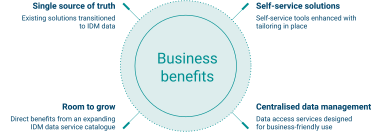
Completion of our data migration program

In FY23 the organisation completed the two-year transition of our data to new strategic platforms.
The transition program saw the successful migration of years of historical data, data models and processes from legacy data platforms to new dedicated, strategic platforms.
This included the reduction of around 900 processes and reports down to 100 strategic solutions, and the migration of around 47 million rows of historical data into one model.
As a result, the Agency is now more data-efficient and able to consume a greater breadth of data that is easy to access and work with, using a range of tailored self-service tools.
The new platform was designed to be a single source of truth and will create greater data analytics and business intelligence more efficiently, supporting enhancements in portfolio insights and investment decision-making.