
01FY23 Performance

Investment environment in 2022–23
In 2021 we issued a call to attention, publishing A New Investment Order which predicted a return of inflation and rising interest rates, more conflict and deglobalisation. We then explained how we are investing in this more challenging world with a second paper – The Death of Traditional Portfolio Construction? The investing environment continues to be shaped by the themes in the papers, with the Future Fund well positioned to navigate this complex new environment.
Much of the 2022–23 financial year was about adjusting to life after the COVID-19 pandemic and to the ongoing war in Ukraine, with these shocks having long-lasting impacts on economies, geopolitics and the way we invest. Firms, households, governments and investors have all had to adjust to changed conditions and more complex circumstances.
Forward-looking returns for traditional portfolios are challenged and we are adapting how we invest.
After central banks increased interest rates sharply, there is still some concern that inflation may not permanently return to a comfortable level without significant cost. Services inflation, for example, is proving hard to beat in some countries as labour markets remain resilient. Financial markets are still confident that central banks can anchor inflation expectations, and the chances of a worst-case wage price spiral appear low – but not zero.
Higher inflation on a more permanent basis would have implications for investors, like the Future Fund, who target real returns. We have spent significant time planning for a range of inflation scenarios and preparing the portfolio for a more complex, challenging and volatile investment environment in the future.
Over the last year there were significant impediments introduced that restricted the free flow of investment and trade. Economies are diverging. Tariffs and trade barriers have been re-emerging; critical supply chains are pivoting to geopolitical allies or were brought onshore. A more assertive China; an emphasis on national security by the Biden Administration; increased tensions around Taiwan; investment bans; and export restrictions on critical minerals added to the challenging backdrop.
Adjusting to a rapid increase in interest rates in 2022–23 was not easy. Some of the investment and economic assumptions made through the years following the global financial crisis of 2008 failed to hold, prompting financial instability. There were flare-ups in market volatility as the UK pension system grappled with a sudden sell-off in UK bonds. In the US, tightened credit conditions led to a small number of regional banks failing. Despite the tighter credit conditions, the US economy in particular, remained resilient.
Looking ahead, how responsive underlying inflation proves to be to interest rate increases so far will determine whether a ‘soft landing’ can be achieved, or whether a deeper economic slowdown will be required to get inflation back within target bands.
In some countries, extraordinary fiscal support at a time of record low levels of unemployment is complicating central banks’ ability to bring down underlying inflation.
In the US, the Inflation Reduction Act of 2022 and the CHIPS and Science Act of 2022 (CHIPS Act) highlight an increasing role of government in economies and markets. The Inflation Reduction Act will lead to significant spending on climate change initiatives. The CHIPS Act highlights the inflationary impacts of building resiliency into economies, of insuring against potential conflicts, and of pursuing a more interventionist approach to industrial policy.
Developments in generative artificial intelligence (AI) sparked the promise of a potential boost to productivity. This could enable economies to grow at higher rates in the longer term and help counterbalance higher inflationary trends elsewhere. Nevertheless, the shorter-term implications of AI on inflation and labour markets are less clear.
Despite the more challenging global environment, equity markets had a strong year, particularly in the second half. Sentiment was buoyed by hopes for a ‘soft landing’, an end to the interest rate hiking cycle, growth prospects around AI and spending on climate change initiatives.
The near-term outlook will depend on how these factors unfold. The investment environment that lies ahead, however, is likely to remain challenging.
Year at a glance

The Future Fund is a long-term fund created to strengthen the Commonwealth’s long-term financial position. The Fund’s 10-year return of 8.8% per annum remains above its benchmark target of 6.9% per annum.
The annual return of 6.0% is a solid result and reflects the significant activity undertaken to reposition the portfolio for difficult conditions. High and sticky inflation, strong labour markets, geopolitical tensions and rising interest rates are making for challenging investment conditions, even as some of the effects of the pandemic dissipate.
The Future Fund is positioned cautiously rather than defensively, and we will remain vigilant and continue adjusting where needed to keep the portfolio resilient in the years ahead with a focus on the long term and risk as per the mandate.
Total funds under management
$256.2bn
At 30 June 2023
Torres Strait
Islander Land and
Sea Future Fund
Drought Fund
Australia Fund
Note(s):
*The Disaster Ready Fund was previously named the Emergency Response Fund until 1 March 2023.
Investment performance
The Future Fund
The Future Fund was established in April 2006 to strengthen the long-term financial position of the Commonwealth of Australia.
Investment mandate
CPI + 4.0%–5.0% per annum
To achieve an average annual return of at least the Consumer Price Index (CPI) + 4.0% to 5.0% per annum over the long term, with an acceptable but not excessive level of risk.
Investment performance
6.0%
pa return in FY23
$206.1bn
value at 30 June 2023
8.8%
pa 10-year return
6.9%
pa target 10-year return
Note(s):
- From 1 July 2017 the Fund’s Investment Mandate target return was reduced from the CPI + 4.5% to 5.5% pa to the CPI + 4.0% to 5.0% pa over the long term, with an acceptable but not excessive level of risk.
- Industry measure showing the level of realised volatility in the portfolio.
Future Fund Equivalent Equity Exposure since inception


Measuring risk
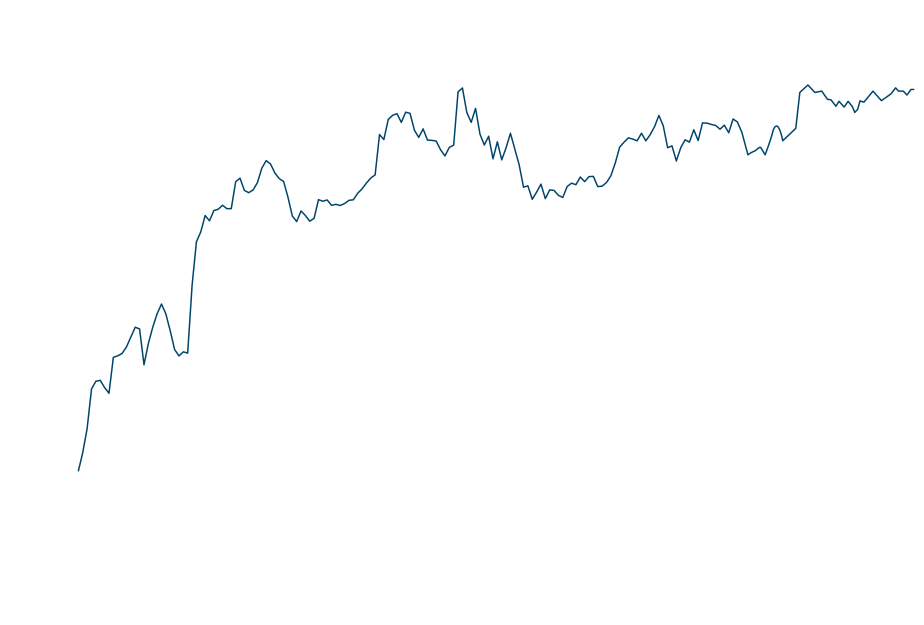
One of the primary metrics we use to understand and manage the broad market risk exposure of the Future Fund is Equivalent Equity Exposure (EEE). EEE estimates the amount of market exposure we have when looking through the whole portfolio.
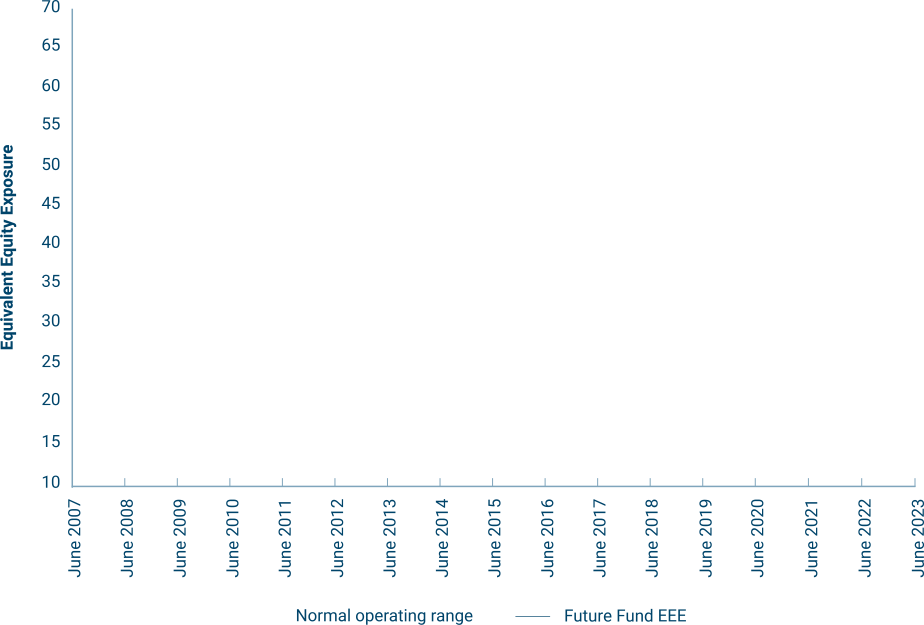
The chart above demonstrates how the EEE of the Future Fund has changed over time. We are currently in the seventh distinct risk-taking regime for the portfolio since establishment.
- The build of the Future Fund portfolio was suspended in late 2007 due to concerns over financial markets stability and the sustainability of high asset prices, and a very low risk profile was maintained into the global financial crisis.
- Portfolio risk exposure was increased as extraordinary and globally coordinated economic policies were implemented to fight the crisis.
- Risk levels were raised further as the European crisis subsided and the President of the European Central Bank committed to ‘do whatever it takes’ to underwrite the integrity of the euro.
- As expected returns declined (given strong market performance supported by low interest rates), portfolio risk was gradually reduced to moderately below normal levels.
- Risk levels were increased towards more normal levels, reflecting the emergence of strong economic growth and corporate earnings, and central banks signalling an extension of accommodative monetary policies, together with the decision to increase the Fund’s structural risk appetite.
- Risk levels were reduced to moderately below neutral, reflecting the elevated risk environment resulting from the COVID-19 pandemic and policy response.
- The structural risk level was adjusted during the 2020–21 financial year and we narrowed the range around which we expect to manage the portfolio. Subsequently, EEE was managed reasonably close to neutral structural levels.
Risk positioning
The EEE range within which we are expected to operate most of the time was reviewed and uplifted to 55–65 as part of the recent deep review of our investment strategy.
Throughout 2022–23, the portfolio risk setting has averaged close to the middle of the range and at 30 June 2023 the EEE stood at 60.
Medical Research Future Fund
The Medical Research Future Fund was established in 2015 and will improve the health and wellbeing of Australians by providing grants of financial assistance to support medical research and medical innovation.
Investment mandate
RBA + 1.5%–2.0% per annum
To achieve at least the Reserve Bank of Australia cash rate target + 1.5% to 2.0% per annum, net of investment fees, over a rolling 10-year term.
Investment performance
4.4%
pa return in FY23
$21.9bn
value at 30 June 2023
Note(s):
- Industry measure showing the level of realised volatility in the portfolio.
Risk positioning
Our expected EEE range for the Medical Research Future Fund is 27–34.
At 30 June 2023, the EEE stood at 30, which is below the middle of the range.
Aboriginal and Torres Strait Islander Land and Sea Future Fund
The Aboriginal and Torres Strait Islander Land and Sea Future Fund (ATSILS Fund) was established in February 2019 to enhance the Commonwealth’s ability to make payments to the Indigenous Land and Sea Corporation.
Investment mandate
CPI + 2.0%–3.0% per annum
To achieve an average annual return of at least the CPI + 2.0% to 3.0% per annum over the long term, with an acceptable but not excessive level of risk.
Investment performance
4.5%
pa return in FY23
$2.1bn
value at 30 June 2023
Note(s):
- Industry measure showing the level of realised volatility in the portfolio.
Future Drought Fund
The Future Drought Fund was established in September 2019 to support initiatives that enhance the drought resilience of Australian farms and communities.
Investment mandate
CPI + 2.0%–3.0% per annum
To achieve an average annual return of at least the CPI + 2.0% to 3.0% per annum over the long term, with an acceptable but not excessive level of risk.
Investment performance
4.7%
pa return in FY23
$4.6bn
value at 30 June 2023
Note(s):
- Industry measure showing the level of realised volatility in the portfolio.
Disaster Ready Fund
The Disaster Ready Fund was initially established as the Emergency Response Fund then renamed on 1 March 2023. It is used to fund natural disaster resilience and risk reduction.
Investment mandate
CPI + 2.0%–3.0% per annum
To achieve an average annual return of at least the CPI + 2.0% to 3.0% per annum over the long term, with an acceptable but not excessive level of risk.
Investment performance
4.6%
pa return in FY23
$4.4bn
value at 30 June 2023
Note(s):
- The Disaster Ready Fund was previously named the Emergency Response Fund until 1 March 2023.
- Industry measure showing the level of realised volatility in the portfolio.
DisabilityCare Australia Fund
The DisabilityCare Australia Fund was established in 2014 to help fund the National Disability Insurance Scheme (NDIS), which will support a better life for Australians with a significant or permanent disability and their families and carers.
Investment mandate
BBSW + 0.3% per annum
To achieve a benchmark return of the Australian three-month bank bill swap rate (BBSW) + 0.3% per annum, calculated on a rolling 12-month basis. Investments must minimise the probability of capital loss over a 12-month horizon.
Investment performance
3.6%
pa return in FY23
$16.9bn
value at 30 June 2023
